Search
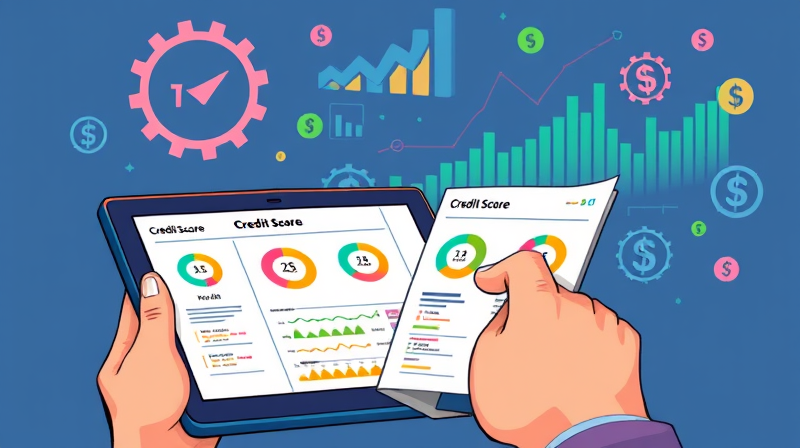
In the world of credit, your score is more than just a number; it's a key that unlocks financial opportunities.
FICO and VantageScore are two competing credit scoring models that analyze the same data but craft your score in different ways.
Both use the same 300-850 score range, yet neither is inherently better—they are simply tools from rival companies.
Understanding their distinctions can help you navigate loans, mortgages, and credit cards with confidence.
This guide dives deep into the nuances, offering practical insights to improve your financial standing.
FICO, developed by Fair Isaac Corporation, has been the industry standard since 1989.
Its latest versions, FICO Score 8 and FICO Score 9, are tailored to specific credit bureaus.
This means your FICO score can vary slightly across Experian, Equifax, and TransUnion reports.
In contrast, VantageScore is a collaborative effort by all three major credit bureaus.
VantageScore 4.0 is the newest model, designed to predict future behavior more accurately by focusing on recent activity.
It operates as a single tri-bureau model, providing consistency across all credit reports.
Knowing where you fall in the score ranges is crucial for assessing your credit health.
For VantageScore 4.0, the categories are clearly defined.
FICO uses different ranges, with a score of at least 670 considered good credit.
General benchmarks show that VantageScore requires at least 700 for good credit.
The weighting of credit factors is where these models truly diverge.
Payment history is the most influential factor in both, but VantageScore emphasizes it more.
FICO places a heavier emphasis on credit utilization at 30%.
Here’s a breakdown of the weightings for each model.
This difference means that managing your credit card balances is critical for FICO.
For VantageScore, consistently making on-time payments can have a bigger impact.
To illustrate, consider the following comparison table of key features.
Minimum history requirements vary significantly between the two models.
FICO requires at least six months of payment history with an account open and reported recently.
VantageScore only needs one month of history, making it more accessible.
Additionally, VantageScore 4.0 uses trended data from up to two years.
This means it analyzes your behavior over time, not just a snapshot.
This innovation helps lenders see if you're consistently paying down debt.
Alternative data like rent and utility payments can influence your score.
VantageScore 4.0 factors in these payments if reported to credit bureaus.
FICO 10 rarely uses this data, which can disadvantage some consumers.
Medical collections are treated differently between the models.
VantageScore ignores paid collections and excludes medical collections from calculations.
FICO weighs medical collections heavily, potentially lowering your score.
This makes VantageScore more forgiving for those with medical debt.
When you apply for credit, hard inquiries can affect your score.
FICO counts multiple inquiries as one if within a 45-day window.
VantageScore narrows this window to just 14 days.
This makes VantageScore more aggressive in treating rate shopping.
Model update frequency is another key difference.
VantageScore updates its scoring model more often to reflect current trends.
FICO updates slowly, which might not capture recent changes in credit behavior.
Staying informed about these updates can help you adapt your credit strategy.
In mortgage lending, VantageScore 4.0 shows strong predictive performance.
It captures 11.2% more mortgage defaults in high-risk populations.
This model outperforms Classic FICO by 3.5% in predicting delinquencies.
Regulatory adoption has increased for VantageScore in recent years.
The FHFA mandates its use for Fannie Mae and Freddie Mac mortgages.
Entities like the Veterans Administration also accept VantageScore 4.0.
This broader access helps more individuals qualify for home loans.
Your FICO and VantageScore may not match due to several factors.
Different weighting of credit factors leads to variations in calculations.
Data rules and requirements also play a significant role.
Emphasis on recent behavior differs between the models.
VantageScore focuses more on recent activity, while FICO has a longer view.
Variations in evaluating alternative data further contribute to score differences.
Bureau-specific models for FICO add another layer of complexity.
To improve your scores, focus on key areas like payment history and credit utilization.
Regularly monitor both scores to understand your financial profile better.
Use tools that provide insights from both models for a comprehensive view.
By leveraging this knowledge, you can take proactive steps toward financial health.
References